
Der Grundstein für unseren Erfolg
An elevator guide rail connecting plate, also known as a guide rail fishplate, is a steel component used to connect two adjacent elevator guide rail sections. It is fastened with bolts to securely join the rails, maintaining precise alignment at the joint and ensuring the elevator car and counterweight travel smoothly and safely along the guide rails.
Since elevator guide rails are manufactured in standard lengths, multiple sections must be joined together to form a continuous guiding system. Although the connecting plate is a relatively small elevator guide rail accessory, it plays a critical role in installation accuracy, operational stability, and the long-term reliability of the entire elevator guiding system.
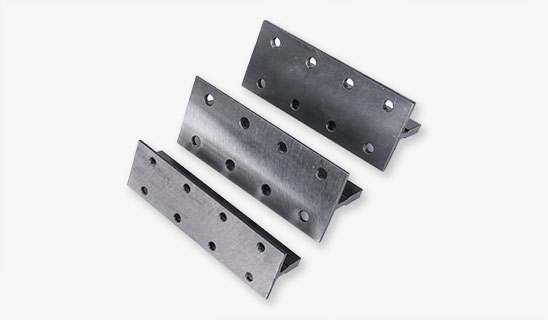
A guide rail connecting plate does more than simply join two rail sections—it is an essential component for maintaining the stability and integrity of the guide rail system.
A high-quality connecting plate keeps adjacent guide rails accurately aligned, allowing guide shoes to pass smoothly over rail joints while reducing vibration, noise, and abnormal wear. It also distributes operating loads evenly across the rail connection, improving overall structural rigidity and helping extend the service life of both the guide rails and fastening components.
Modern guide rail connecting plates are typically manufactured from high-strength steel and precision-machined to ensure dimensional accuracy and interchangeability. This helps minimize on-site adjustments and improves installation efficiency.
Any elevator system consisting of multiple guide rail sections requires connecting plates to create a secure, continuous guide path. They are widely used in various elevator applications, including:
1. Passenger elevators
2. Freight elevators
3. Hospital elevators
4. Commercial building elevators
5. High-rise building elevators
6. Industrial elevators
Whether the system uses solid guide rails or hollow guide rails, the connecting plate must match the rail specifications to ensure accurate installation and long-term operational stability.
Guide rail connecting plates are generally classified into two types based on the guide rail structure.
Designed for solid guide rails, this type provides excellent strength and rigidity. It is commonly used in high-speed elevators, heavy-duty freight elevators, and high-rise building projects where greater load capacity is required.
Designed for hollow guide rails, this type reduces overall system weight while maintaining reliable rail connections. It is widely used in passenger elevators for residential buildings, office buildings, and commercial facilities.
To ensure proper performance, the connecting plate should always match the guide rail profile, dimensions, and bolt-hole configuration.
When selecting a guide rail connecting plate, consider the following factors:
|
Consideration |
Why It Matters |
|
Guide rail model |
Ensures the connecting plate matches the guide rail dimensions and bolt-hole pattern. |
|
Material strength |
High-strength steel provides greater load capacity and durability. |
|
Machining accuracy |
Precision machining improves installation accuracy and reduces on-site adjustments. |
|
Surface treatment |
Corrosion-resistant finishes help extend service life in different operating environments. |
|
Quality control |
Consistent manufacturing ensures reliable product quality and long-term performance. |
In addition, different countries and projects may follow different elevator standards, such as EN 81 or other local regulations. Before purchasing, confirm that the connecting plate is compatible with your guide rail system and complies with the applicable project requirements.
For large-scale elevator projects, it is recommended to source the guide rails, connecting plates, and fastening components from the same manufacturer. This helps improve system compatibility, simplifies installation, and reduces future maintenance costs.
Although an elevator guide rail connecting plate is a relatively small component, it plays a vital role in ensuring guide rail installation quality and elevator safety. Choosing connecting plates with the correct dimensions, high machining accuracy, and reliable quality can improve installation efficiency, reduce maintenance costs, and provide long-term support for the entire guide rail system.
For elevator manufacturers, installation contractors, and engineering procurement teams, working with an experienced guide rail supplier helps ensure the guide rail connection system meets project requirements and delivers reliable, long-term elevator performance.
Yes. Guide Rail Connecting Plate and Guide Rail Fishplate generally refer to the same component used to connect two adjacent elevator guide rail sections.
Yes. If the connecting plate becomes deformed, cracked, severely corroded, or has worn bolt holes, it can usually be replaced individually after inspecting the condition of the guide rails.
Compatibility should be determined by the guide rail model, dimensions, bolt-hole configuration, installation method, and applicable project standards to ensure proper system performance.