
Der Grundstein für unseren Erfolg
Guide rail clips are small components with a disproportionately large impact on system performance. Whether used in elevator installations or industrial rail-guided machinery, these fastening elements play a decisive role in alignment accuracy, load transfer, vibration control, and long-term operational safety. From a practical engineering perspective, understanding how guide rail clips work—and how to select them correctly—is essential for achieving reliable and compliant installations.
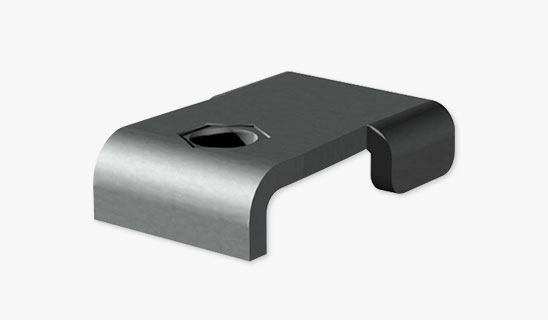
Guide rail clips are mechanical fasteners designed to secure guide rails to supporting structures such as concrete walls, steel frames, or machine bases. Their primary function is to hold the guide rail in a precise position while allowing the system to perform smoothly under static and dynamic loads.
In elevator systems, guide rail clips ensure that elevator guide rails remain accurately aligned along the shaft, directly influencing ride comfort, noise levels, and safety performance. In industrial applications, guide rail clips are used to stabilize linear motion rails, conveyor guide systems, and automated machinery tracks.
What makes guide rail clips essential is their dual responsibility: providing firm fixation while accommodating controlled movement. Improper fixation—either too rigid or too loose—can lead to rail deformation, excessive vibration, accelerated wear, or even system failure. For this reason, guide rail clips are not simple brackets but engineered components designed around load behavior, tolerances, and environmental conditions.
Guide rail clips can be categorized based on both structural design and installation method, each type serving specific operational requirements.
From a design standpoint, the most common types include fixed (rigid) guide rail clips and adjustable guide rail clips. Fixed clips provide high rigidity and are typically used where rail alignment is already well controlled and structural movement is minimal. Adjustable guide rail clips, on the other hand, allow fine positioning during installation, making them ideal for elevator guide rail alignment where vertical accuracy is critical.
Another important category is elastic or spring-type guide rail clips. These designs introduce controlled flexibility, enabling the rail system to absorb vibration and accommodate thermal expansion without transmitting excessive stress to the rail or support structure.
In terms of fixation method, guide rail clips may be bolt-on, welded, or clamp-type. Bolt-on guide rail clips are the most widely used due to ease of installation and maintenance. Welded clips offer high strength but reduce adjustability and are more common in heavy industrial machinery. Clamp-type guide rail clips are often used in modular systems where fast assembly and disassembly are required.
Each type reflects a trade-off between rigidity, adjustability, and ease of installation—factors that must be evaluated at the system design stage.
The functions of guide rail clips extend far beyond simple fixation. Their engineering value lies in how they manage forces and motion within the system.
One core function is load transfer and force distribution. Guide rail clips transmit vertical and lateral loads from the rail into the supporting structure, preventing localized stress concentration that could damage rails or anchors. Proper clip spacing and strength ratings are critical to achieving balanced load paths.
Another essential function is alignment control. Guide rail clips maintain rail straightness and positional accuracy along the entire length of the installation. In elevator guide rail systems, even minor misalignment can result in increased guide shoe wear, vibration, or noise during operation.
Guide rail clips also contribute to vibration damping and noise reduction, especially when elastic elements or isolation pads are incorporated. This function is particularly valuable in high-speed elevators and precision industrial equipment, where vibration directly affects performance and user experience.
Finally, many modern guide rail clips are designed to compensate for thermal expansion and structural tolerance. Buildings, machinery frames, and rails all expand and contract under temperature changes. Clips that allow controlled movement help prevent rail buckling or excessive internal stress.
In elevator systems, guide rail clips are indispensable components. They fix both car guide rails and counterweight guide rails to the shaft wall or steel structure. Compliance with installation tolerances is essential, as elevator standards specify strict limits on rail deviation, clip spacing, and fixation strength. High-quality elevator guide rail clips directly influence ride comfort, operational noise, and long-term reliability.
In industrial machinery, guide rail clips are widely used in linear motion systems, automated production lines, CNC equipment, and conveyor guide rails. Unlike elevator systems, industrial applications often involve higher dynamic loads, frequent start-stop cycles, and harsher environments. As a result, guide rail clips used in machinery typically emphasize fatigue resistance, surface treatment, and ease of replacement.
While the fundamental function remains the same, the design requirements differ significantly between elevators and industrial systems. Understanding these differences helps engineers and buyers avoid using unsuitable clip designs that compromise performance or service life.
Selecting the correct guide rail clip requires a systematic evaluation of technical parameters rather than a one-size-fits-all approach.
First, load capacity and rail size compatibility must be verified. The clip must match the rail profile and safely handle static loads, dynamic forces, and safety factors defined by the application.
Second, environmental conditions play a major role. Corrosive environments, high humidity, or temperature fluctuations demand appropriate materials such as galvanized steel or stainless steel, along with suitable surface treatments.
Third, consider installation and maintenance requirements. Adjustable guide rail clips may reduce installation time and improve alignment accuracy, while standardized bolt-on designs simplify inspection and replacement.
Finally, compliance with industry standards should never be overlooked. For elevator guide rail clips, adherence to relevant national or international standards is not optional—it is a prerequisite for safety certification and long-term operation.
A well-selected guide rail clip not only improves system performance but also reduces maintenance costs and extends service life.